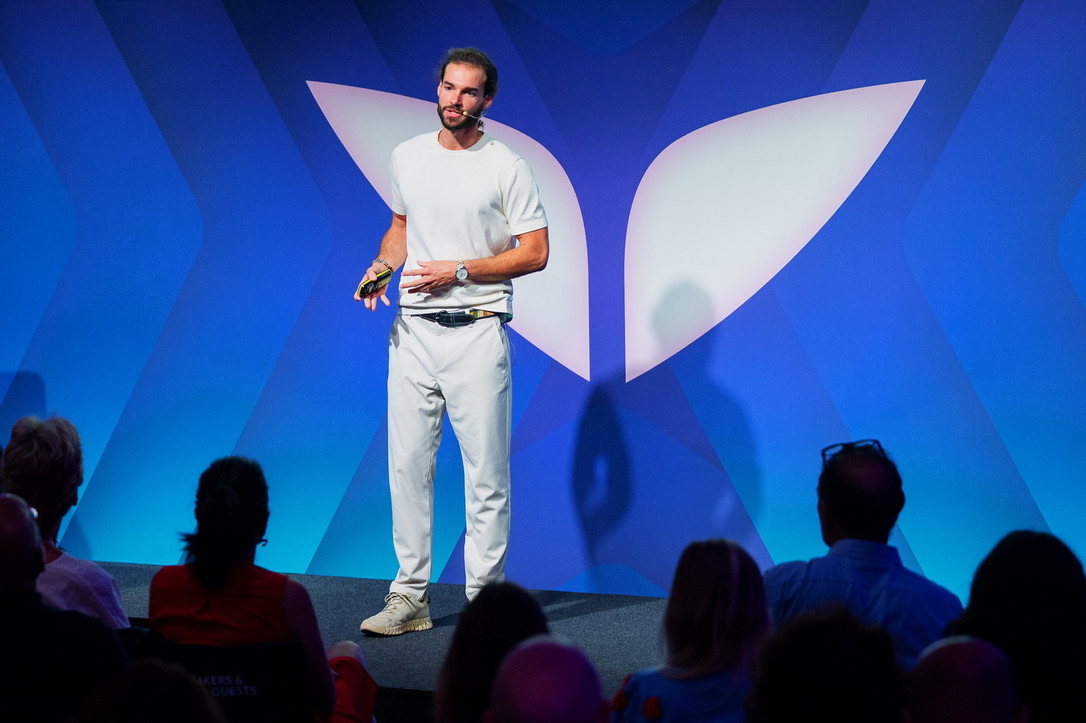
Entrepreneurship in the AI era starts with a familiar question: what is worth building? The tools can make new things possible, but someone still has to understand a problem, choose a direction, talk to people, and decide what to do with the feedback. Rui Vas brings that builder’s perspective to talks about AI, adaptability, and human potential.
His experience crosses robotics research, product leadership, AI ventures, and teaching. It also includes a personal process of burnout and rebuilding that changed how he thinks about ambition and change. For founders, leaders, and teams, the result is an inspirational speaking approach grounded in experience and connected to practical decisions.
An entrepreneur who works with AI and teaches it
Rui has been researching AI since 2016, beginning in the robotics labs at EPFL. He later worked in AI, machine learning, and MLOps product management at Canonical, the company behind Ubuntu. Alongside that technical and product background, he founded AI ventures across Silicon Valley and Europe.
He has taught more than 3,000 people to build and create with AI through different courses and learning experiences. That adds another perspective to the entrepreneurial story: knowing something is different from making it understandable and usable for another person. Teaching requires clear language, relevant examples, and a willingness to meet people at different starting points.
These experiences inform talks for people who want to engage with technology actively. The focus can be founding a business, choosing an experiment inside a larger organization, or developing the confidence to use unfamiliar tools. The shared theme is turning curiosity into a deliberate next step.
From a problem to an AI product: the Radiobooks story
Radiobooks explored whether AI narration could make audiobook production more viable for smaller language markets. Rui built a production pipeline using text-to-speech and SSML, developed a consumer audiobook application, and secured paid proof-of-concepts with publishers and a distributor. Pilot clients include LeYa, Porto Editora, Clube de Autores, and Bookwire.
For an entrepreneurial audience, the interesting questions extend beyond the technology. What makes the production economics worth exploring? What does a publisher need to judge a sample? How does a prototype become a conversation with a customer? How do you test distribution when you are creating something people do not already use?
Rui’s story includes a very physical distribution experiment: placing 6,000 QR-coded stickers around Portuguese cities by motorbike, which brought a few thousand app sign-ups. It is a memorable example of combining a technical product with direct experimentation in the world. The lesson can be discussed in terms of initiative, testing assumptions, and finding ways to reach people.
The Radiobooks case study contains more detail. In a talk, the story can be adapted to the audience’s interest in product discovery, creative applications of AI, or the practical work of building a venture.
Customer discovery and the Silicon Valley experience
Rui founded TechOS, a software marketplace, and went through Founder Institute Silicon Valley in Palo Alto. The experience involved a 14-week programme with weekly pitching and more than 200 conversations with prospects, developers, and CXOs across the United States, the United Kingdom, and Switzerland.
That experience provides material for a useful conversation about listening. An idea can sound compelling in a pitch and still leave important questions unanswered. Who experiences the problem? How do they solve it today? What do they value enough to pay for? What changes when a founder hears a different answer from the person they expected to serve?
A talk can use those questions to make entrepreneurship feel concrete. Participants do not need to be raising investment to benefit from customer discovery. A manager testing an internal AI workflow also needs to understand the user. A product team considering a new feature needs evidence that the feature addresses something meaningful.
Founder Institute later invited Rui to co-direct a Portugal cohort. His wider experience also includes mentoring for a Techstars ABN AMRO cohort. These roles connect the founder’s perspective with helping other people work through their own questions and decisions.
What product leadership adds to an inspirational talk
At Canonical, Rui worked in the Kubeflow ecosystem across product, documentation, go-to-market, and open-source contribution. His experience includes live education for an audience of 1,000 and webinars with Dell, Lenovo, and NVIDIA. He also worked closely with Canonical’s founder, Mark Shuttleworth.
For a leadership or entrepreneurial audience, that background opens a discussion about serving different people around the same product. A technical community, a commercial buyer, and a company funding development can have different priorities. Product decisions require understanding those perspectives and making trade-offs explicit.
It also illustrates the importance of explanation. Documentation and education are part of making a product usable. The idea has to survive contact with another person’s questions, constraints, and working environment. That is relevant to leaders introducing AI internally as much as it is to teams building a new tool.
These are useful foundations for an inspirational message because they give the audience something to examine. A story about change becomes more meaningful when people can connect it to a decision in their own work.
Adaptability without losing the human side
Rui’s personal story includes burnout and rebuilding. That experience informs the emphasis he places on people feeling capable as technology changes around them. It is possible to be interested in the future and still find the pace difficult. A useful conversation can acknowledge that tension and make room for a response that people can sustain.
His personal development activities include Kung Fu, Qi Gong, Shiatsu, movement, sauna, cold plunge, and ecstatic dance. He describes these as embodiment practices and ways to explore attention, presence, and connection. They are part of his personal story, rather than a prescribed programme for an audience.
When appropriate to the event, that perspective can deepen a talk about adaptability. Learning is not only collecting information. It also involves noticing how people respond to uncertainty, making room to practise, and finding a pace at which they can continue. The relevance of the personal material is discussed in the brief.
The About me page provides more context on these practices and Rui’s human approach to technology. An event organizer can use it to assess whether this dimension fits the audience and the tone of the programme.
Talk themes for founders, leaders, and teams
Building with AI: start with a problem worth solving
This angle connects AI tools with customer discovery and product thinking. It can explore how to frame a problem, choose a manageable experiment, and assess whether the result is useful. The examples draw on venture building and teaching, with the level of technical detail adapted to the audience.
Thrive in Change: curiosity, capability, and a next step
Rui’s signature keynote brings together adaptability, AI understanding, creativity, and practical action. It can serve an opening conference session, a leadership event, or an accelerator audience. The signature keynote format is 20–45 minutes, with the final structure agreed around the event.
From technical possibility to human adoption
This theme explores the distance between showing that something works and helping people use it. Product experience and classroom examples can make the discussion tangible. Leaders can connect the ideas to introducing a workflow, communicating a change, or supporting a team through an experiment.
The entrepreneur as a learner
Pitching, customer conversations, product decisions, and teaching all involve receiving feedback. This angle focuses on curiosity and the willingness to refine an approach. It can be relevant to founder communities and to established teams that want to develop a more experimental way of working.
Who this speaking approach is for
Founder communities and accelerators may want a talk that connects ambition with the practical work of discovery and building. Leadership teams may want a human perspective on adopting technology. Universities and professional communities may want to show people how technical knowledge, entrepreneurship, and communication can reinforce one another.
For a conference organizer, the value is in choosing a clear purpose for the session. A broad inspirational keynote creates a shared perspective. A more practical AI talk can explain tools and workflows. A workshop gives participants time to try something themselves. The formats can complement each other when their roles are clear.
Rui’s speaking and training languages are English and Portuguese. For an event in Portugal or Spain, discuss location, dates, audience language, and delivery arrangements during the enquiry. The programme should be planned around what the audience can follow and what the event can support.
Evidence, audience feedback, and fit
Rui’s Mindvalley speaker rating is 9.1/10 across more than 290 responses. His teaching feedback highlights clear explanations, patience, and practical understanding. These are relevant signals for organizers looking for a speaker who can translate a complex subject without losing the room.
You can read the original testimonials and messages, watch the speaking clip, and explore the selected projects and workshops. The strongest booking decision comes from matching that experience to your audience’s needs, rather than assuming that one talk works equally well for every room.
A discovery call helps establish the fit. Share the event theme, who will attend, what they are experiencing, and the conversation you want to open. Rui can then discuss which stories, examples, and level of practical detail belong in the session.
Questions about entrepreneurial and inspirational speaking
Is this relevant to people who are not founders?
Yes, when the content is framed around decisions the audience recognizes. Understanding a problem, testing an idea, learning from feedback, and helping people adopt a change are useful themes inside established organizations as well as new ventures.
Can the personal story be part of the talk?
Yes. Rui’s experience of burnout, rebuilding, and embodiment can inform the human side of a session. The balance between personal narrative, entrepreneurial experience, and AI examples should follow the event’s purpose.
Can the audience work with the tools afterward?
A workshop can follow a keynote to give participants practice time. The training can focus on a tool, a workflow, or a defined learning outcome. Plan access, participant experience, and total duration as a separate part of the programme.
What should I include in an enquiry?
Include the event date and location, audience roles, approximate participant count, preferred delivery language, running time, and desired theme. If you are still shaping the event, start with the audience and what you want people to take away. A free discovery call can help turn that into a clearer brief.