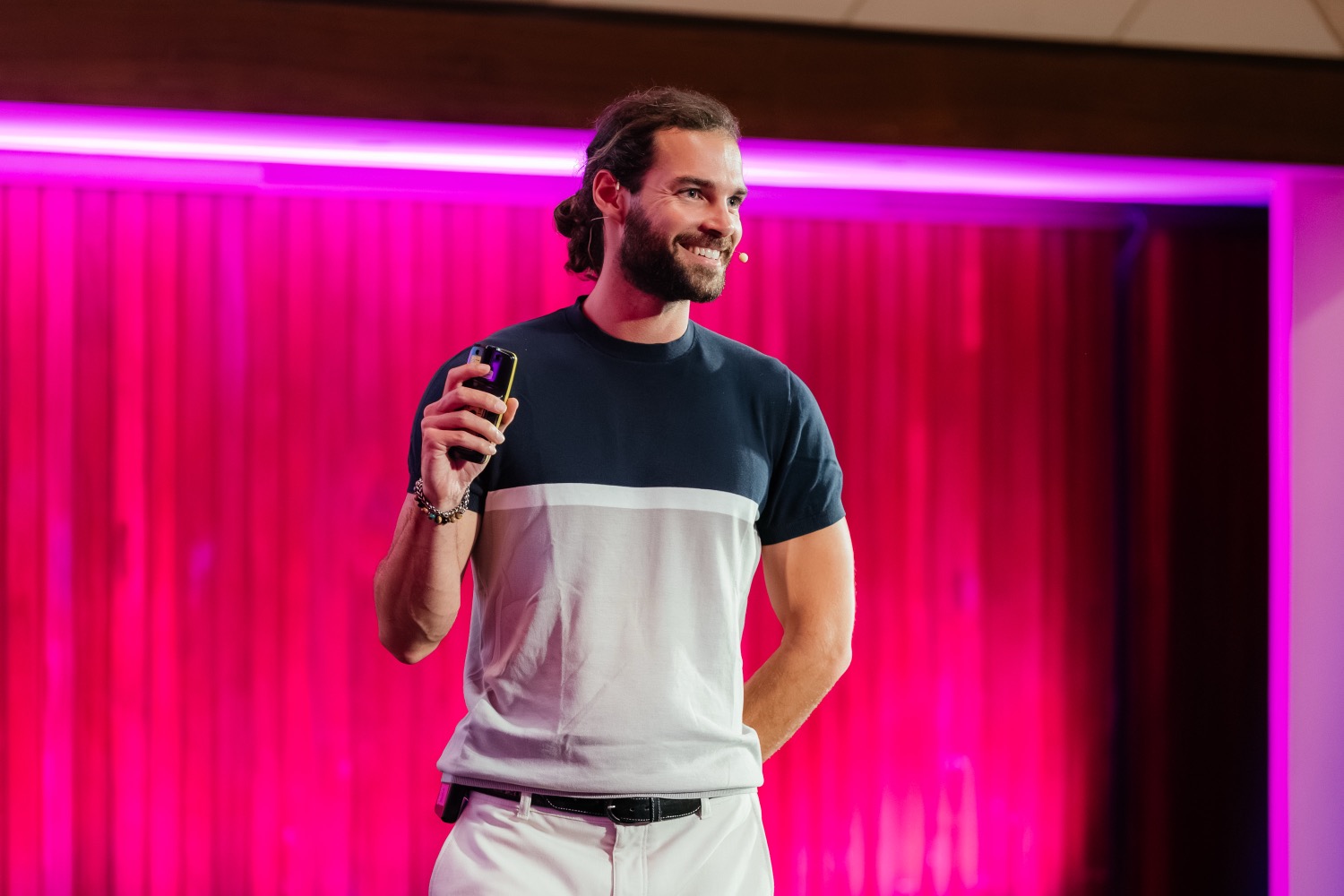
An AI keynote should give an audience a useful way to think about change. Some people arrive excited by the tools. Others are worried about their role, overwhelmed by competing claims, or unsure where to begin. A good speaker can meet those different starting points and bring the room into the same conversation.
Rui Vas speaks about AI through the experience of researching, building, teaching, and adapting. His central message is simple: AI is here. Panic is optional. For event organizers in Portugal and Spain, his talks offer a combination of inspiration, practical explanation, and an entrepreneurial perspective on what people can do next.
Inspirational AI talks with something to use afterward
Inspiration is valuable when it creates room for action. People need a reason to engage with change and a manageable first step. Rui’s speaking connects the human experience of uncertainty with concrete examples of AI tools and workflows. The intention is to help audiences feel capable enough to explore rather than leave with another overwhelming list.
That balance can serve conferences, leadership events, company gatherings, universities, and accelerator programmes. The emphasis depends on the room. A broad audience may need a clear introduction and a sense of possibility. A leadership team may want a sharper conversation about priorities. Founders may respond to the decisions behind building a product or testing an opportunity.
The content is shaped around the event’s purpose. If the audience should leave motivated to experiment, the talk can make experimentation approachable. If the goal is a shared understanding of AI, the examples can establish useful concepts. If the event is launching a training initiative, a keynote can create the context for hands-on sessions that follow.
The signature keynote: Thrive in Change
Thrive in Change explores how people can adapt as AI changes the way they work. It combines a field report from building with technology and a practical map for engaging with it. The focus is on understanding the tools, keeping a human perspective, and choosing meaningful action.
The signature keynote format is 20–45 minutes, with delivery in English or Portuguese. The final running time, audience interaction, demonstration scope, and any questions should be agreed during event planning. A short opening talk and a longer conference slot call for different levels of detail.
- Build adaptability: find a useful response when familiar assumptions are changing.
- Understand AI: replace vague impressions with clear explanations of what tools can and cannot do.
- Stay human: consider creativity, judgment, and confidence alongside technical capability.
- Choose a next step: connect an idea from the stage to something people can try in their work.
Rui’s signature keynote overview introduces the talk, while the live speaking clip shows a moment from a real room. Together, they give organizers a starting point for evaluating tone, subject matter, and delivery.
A practical, tools-based AI keynote
For audiences asking what they can actually do with AI, the talk can place more emphasis on tools and examples. A practical keynote may explain how a conversational assistant handles context, what an AI coding agent does, or how several tools connect around a workflow. The examples should support a clear idea rather than become a rapid sequence of unrelated product names.
Rui uses tools including ChatGPT, Claude, Codex, Cursor, Gemini, Microsoft Copilot, Lovable, Replit, Make, and n8n across his wider toolkit. The appropriate selection depends on the audience and the task. An executive audience does not need the same depth of code as a developer conference. A creative team may connect more readily with an example about turning an idea into a first draft or prototype.
Live demonstrations can be discussed during briefing. They need a defined purpose, reliable access, and an agreed approach if a tool behaves unexpectedly. A recorded example may sometimes communicate the point more clearly within a short slot. The decision should serve the audience’s understanding and the event’s schedule.
A tools-based talk is different from a workshop. It can show possibilities and explain a process, but it does not give everyone the same practice time as a facilitated session. If the goal is for participants to complete a task themselves, consider pairing the keynote with a hands-on workshop.
An inspirational AI keynote with a founder’s perspective
Technical change is also a human experience. People can feel pressure to keep up, uncertainty about their future, or frustration when the promise of a tool does not match their first attempt. Rui’s approach acknowledges that experience and connects it to the curiosity and adaptability involved in building things.
His background spans AI research at EPFL, AI and machine learning product work at Canonical, and venture building across Silicon Valley and Europe. That gives the talk material beyond an overview of industry headlines. The entrepreneurial perspective concerns choices: which problem deserves attention, what can be tested, what people need, and how to keep learning when the first approach changes.
Rui also speaks from personal experience of burnout and rebuilding. That experience informs his emphasis on the human side of technology. It can be relevant for audiences discussing leadership, sustainable ambition, or personal reinvention. The brief determines how much of that personal story belongs in the talk.
For a more detailed view of this angle, explore Rui’s entrepreneurial and inspirational speaking. It is particularly relevant to founder communities, accelerators, and leaders navigating change.
Technical credibility, delivered in clear language
Rui has been researching AI since 2016, beginning in robotics at EPFL. At Canonical, he worked on AI, machine learning, and MLOps products in the Kubeflow ecosystem. His work includes documentation contributions, live education, and webinars with technology partners including Dell, Lenovo, and NVIDIA.
He has also taught more than 3,000 people to build and create with AI through courses and learning experiences. That teaching background matters on stage: an explanation has to work for the person hearing it, not just for the person delivering it. A useful analogy, a clear schematic, or a well-chosen example can make an unfamiliar concept easier to discuss.
The result is a speaking proposition for organizations that want technical substance and accessible delivery in the same session. Organizers can inspect the case studies, review the toolkit, and ask how the content would be adapted to their event’s audience.
What audiences say about the experience
At Mindvalley, Rui received a 9.1/10 speaker rating across more than 290 responses. Student comments highlight clear explanations, practical teaching, and a patient, organized style. One Mindvalley AI Mastery student wrote: “Rui is an amazing instructor. He knows how to make the complex, simple.”
Feedback from the Lisbon AI Summit also speaks to practical relevance. Nuno Couto described Rui’s talk as the best of the day for him, highlighting practical insights and everyday accelerators. The original message is available among the homepage testimonials, alongside other audience and student comments.
Audience feedback offers a direct view of the experience: clarity, practical relevance, and an ability to explain unfamiliar ideas. Bring your event’s objectives to the briefing conversation so that those strengths can be focused on the people you are inviting.
Planning a keynote in Portugal or Spain
Start with the audience and the role the talk should play in the event. Is it an opening keynote to establish a shared perspective, a practical session later in the programme, or an internal leadership conversation? Explain what people already know, what they may be concerned about, and what you want the room discussing afterward.
Rui delivers talks in English and Portuguese. For events in Portugal, that can support local and international audiences. For an event in Spain, share the audience’s working language so delivery can be discussed clearly. Location, dates, travel, and online or in-person format are agreed during the enquiry.
Useful production details include the allotted running time, expected audience size, room setup, screen format, audio, and whether the session is being recorded. If there will be a demonstration, discuss connectivity and tool access in advance. If questions are part of the slot, reserve time for them when setting the agenda.
A practical brief also identifies what success would look like for the organizer. That might be stronger participation in an upcoming AI initiative, a shared vocabulary among leaders, or an audience that leaves with a specific next action. Agreeing that intention helps shape the talk’s examples and closing message.
Choosing the best AI keynote speaker for your audience
Start by deciding which combination of inspiration, technical detail, and practical examples the event needs. Watch a speaking sample and read feedback from people who attended. Ask about the speaker’s direct experience with the subject and how the talk changes for different audiences.
For a practical AI event, consider whether the speaker can explain the decisions behind an example, including its limits. For an inspirational event, consider whether the personal story connects to an actionable idea. For leadership audiences, look for the ability to relate possibilities to organizational choices without making unsupported promises.
Rui is a strong option when an organizer wants an entrepreneur and educator who can connect technology with the human experience of change. His talks combine AI understanding, building experience, and an accessible teaching style. The discovery call is the place to assess the match and establish a realistic scope.
Common questions from event organizers
Can the talk be inspirational and practical?
Yes. The balance is part of the brief. A talk can give people a useful perspective on adaptability and then ground that perspective in tools, examples, or a next experiment. The final structure depends on audience knowledge and the time available.
Can a keynote be followed by a workshop?
Yes. A keynote can open the conversation, while a workshop gives participants time to practise. The workshop should have its own learning goal, tool access, and schedule. Explore the AI training overview for the distinction between formats.
Can we discuss a company-specific event?
Yes. Share the industry, participants’ roles, event theme, and what is happening in the organization. Those details help identify examples and questions that are relevant to the room. The scope of preparation is agreed as part of the booking.
How do we enquire about dates and fees?
Book a free discovery call or email Rui with the event date, location, audience, preferred language, and running time. If those details are still flexible, explain what you know so far. The conversation can help you choose between a keynote, workshop, or a combination.